Porosity remains one of the most costly and persistent defects in high-pressure die casting, often leading to part rejection, rework and delayed delivery. The adoption of closed-loop control systems on modern die casting machines addresses this root problem by dynamically adjusting real-time process variables instead of relying on static preset values. This article breaks down the technical mechanism, practical implementation and production benefits of this intelligent die casting technology.
The Root Cause of Porosity in Conventional Die Casting
Porosity forms mainly from entrapped gas and molten metal shrinkage. Traditional die casting machines run on fixed pressure and speed profiles. When raw material temperature, mold surface condition or shot chamber wear fluctuates, the pre-set parameters cannot adapt.
- Turbulent metal flow traps air inside the cavity
- Inconsistent fast-shot timing creates gas pockets
- Unstable intensification pressure fails to compensate metal shrinkage
Even experienced operators struggle to manually tweak parameters to counteract these continuous minor variations in mass production.
Working Principle of Closed-Loop Control on Die Casting Machines
Closed-loop control integrates high-speed pressure sensors, displacement transducers and industrial controllers into the die casting machine’s shot system.
- Sensors continuously collect real-time data: plunger position, shot speed, cavity pressure and molten metal temperature
- The control unit compares measured values against target curves
- The system automatically corrects hydraulic output within milliseconds to maintain the ideal shot profile
Unlike open-loop systems that execute pre-programmed commands only, closed-loop feedback makes the die casting machine self-adjusting during every single shot cycle. It stabilizes slow shot, fast shot switch point and final intensification pressure, greatly reducing gas entrapment.
Production Benefits for Die Casting Workshops- Lower porosity rate: Reduce scrap rate for thin-wall aluminum castings such as automotive structural parts and radiator heat sinks
- Consistent part quality: Dimensional stability across long batch runs
- Less reliance on senior operators: The intelligent system maintains process window, cutting human error
- Extended mold service life: Smoother metal filling reduces mold impact and thermal fatigue
- Better repeatability for downstream processes like CNC machining and surface coating
- Sensor installation: Sensors must be properly shielded from high temperature and metal splash in harsh die casting environments
- Data calibration: Baseline curve calibration is required for each mold and alloy grade.
- Maintenance routine: Regular inspection of plunger, sealing rings and hydraulic circuits to guarantee signal accuracy
- Staff training: Technicians need to understand process curve analysis rather than only manual parameter adjustment
Closed-loop control is transforming high-pressure die casting from experience-based craftsmanship into data-driven manufacturing. Die casting machines equipped with this intelligent control unlock stable production, fewer porosity defects and higher overall equipment effectiveness. With decades of manufacturing expertise, our team supplies full die casting production lines and reliable die casting machines with optional closed-loop control modules to help factories upgrade their casting process.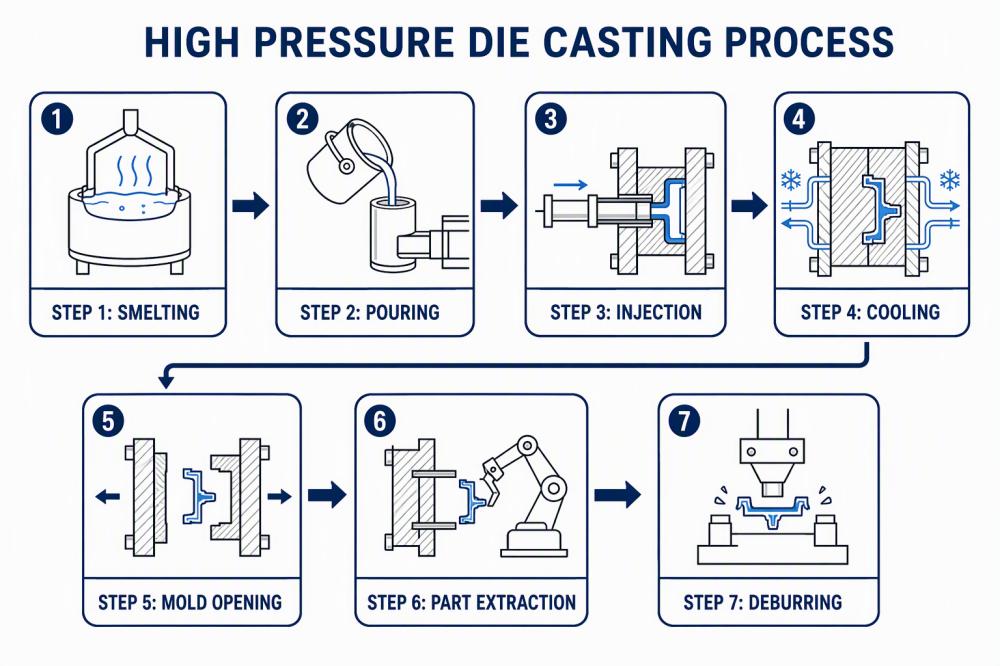
FAQ
Q1: Can closed-loop control eliminate porosity 100%?
A1: No. It drastically reduces gas porosity, but shrinkage porosity still needs mold gating and cooling system optimization.
Q2: Is closed-loop control available for retrofitting old die casting machines?
A2: Many existing hydraulic die casting machines support sensor and controller retrofits after feasibility assessment.
Q3: What main data signals does closed-loop die casting control monitor?
A3: Plunger displacement, shot speed, cavity pressure and molten metal temperature.
Q4: Which casting products benefit most from this technology?
A4: Automotive aluminum parts, heat sinks and thin-wall structural components requiring airtight performance.